Stick welding is a versatile process used across various industries that involves melting a metal rod – the electrode – which fuses two pieces of metal together. Selecting the right stick electrode is a crucial step in the welding process, determining both the quality and ease of your work.
Understanding the different types of electrodes and their applications will help you achieve strong and durable welds. When choosing an electrode for stick welding, you’ll encounter a variety of options, each tailored to specific tasks and types of metal.
Your choice should consider the electrode’s tensile strength, suitable welding positions, and compatibility with different power sources. Knowing the mechanical properties and the type of power source an electrode operates with, such as AC, DCEP, or DCEN, can also impact your decision.
The composition of the electrode is another essential factor, as it should ideally match the base metal you’re working with. This ensures a seamless and strong weld, with some electrodes designed to cater to different metallurgical compositions.
The electrode’s classification provides insight into its capabilities, such as the strength of the resulting weld and the positions in which it can be effectively used.
The Basics of Stick Welding
Stick welding, also known as Shielded Metal Arc Welding (SMAW) or Manual Metal Arc (MMA) welding, is a manual arc welding process that is versatile and straightforward. You’ll need a stick electrode, a stick welder, and your skill to control the arc.
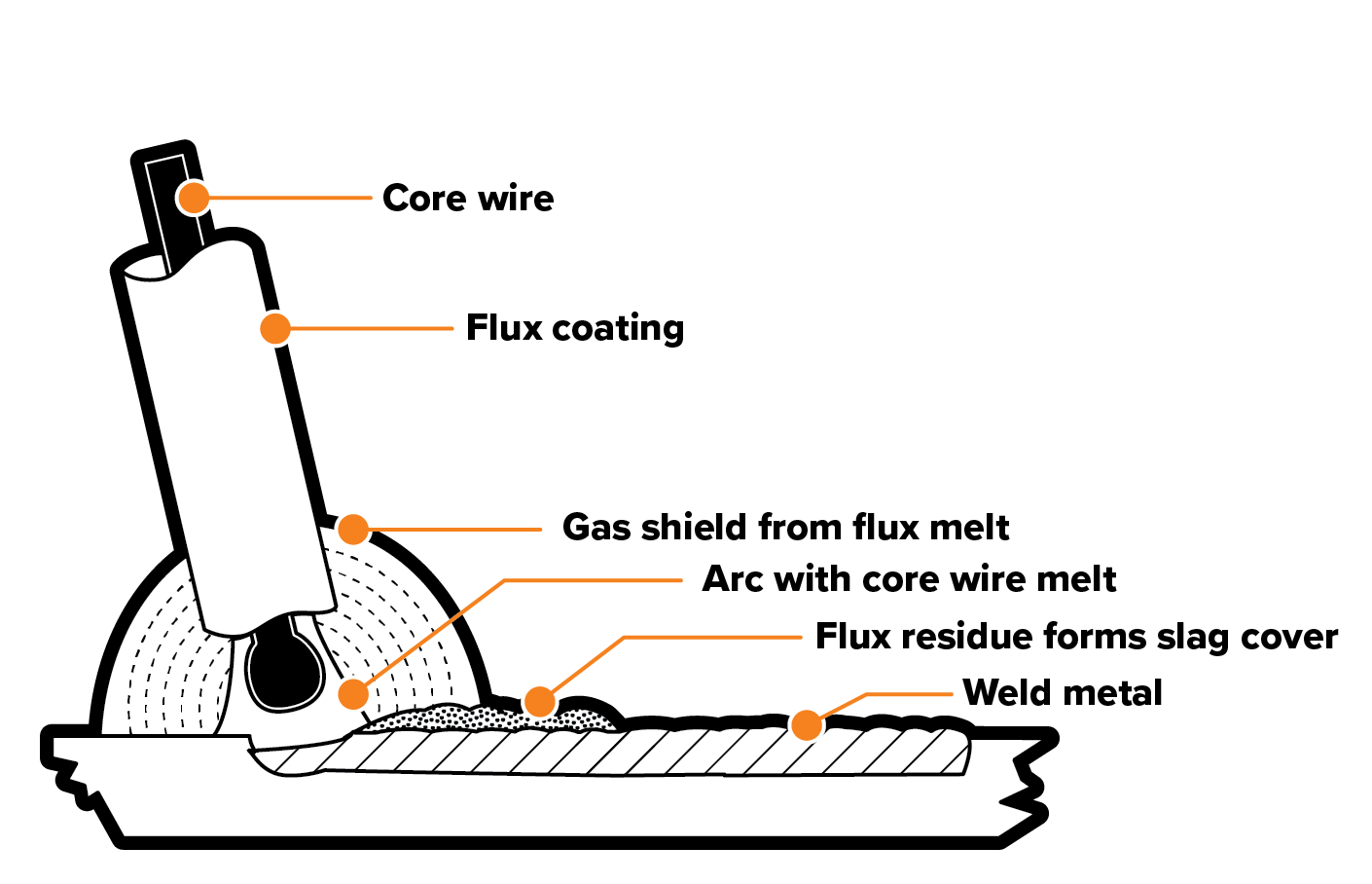
Selecting a stick electrode is crucial as it conducts the current and melts into the joint to form the weld. Your choice depends on the base material, the type of job at hand, and the electrode’s coating, diameter, and compatibility with your workpiece.
- Electrode diameter: influences the necessary amperage and the deposition rate. Common electrode sizes range from 1.6mm to 4.0mm.
- Material compatibility: ensure the electrode material is compatible with the workpiece to prevent weld defects.
The welding current can be either alternating current (AC) or direct current (DC). Your choice will depend on whether the electrode is capable of both, and if it is, the selected current can affect the weld quality and ease of welding.
The welding position is also important, as not every electrode is usable in every position, so it can determine electrode type and the quality of the finished weld. Common positions include flat, vertical, overhead, and horizontal.
Your welding machine should match the electrode’s requirements and be able to handle the job’s duration, offering a consistent power supply to maintain a stable arc.
It’s also a good idea to check that it can run the type of electrode you want to use. Some electrodes are harder to strike an arc with and require a certain open current voltage (OCV), depending on their flux composition. If the machine’s OCV is too low, these electrodes can be difficult to start, the arc may repeatedly go out, or the weld may feel erratic and unstable.
Stick Electrode Selection Guide
When selecting the proper stick welding electrode, you must consider the type of electrode, base metal, the welding current and polarity, and the welding position for your project.
AWS Electrode Identification
Each stick welding electrode is categorised by an American Welding Society (AWS) classification, which provides key details about the electrode’s capabilities. The AWS classification can be found printed on the end of the electrode itself and looks like this: E6013.
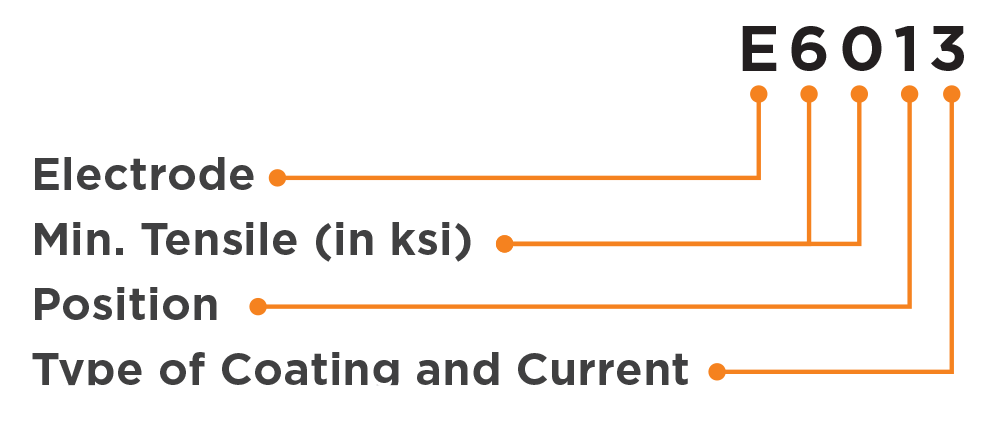
These digits each have a meaning that relates to the electrode’s characteristics and properties.
- The ‘E’ indicates electrode
- The first two digits refer to the tensile strength (how much weight it can withstand after welding) of the electrode
- The 3rd digit indicates the position (see below) that the electrode can be used in
- The 4th digit indicates the flux coating and the current to be used
The ‘E’ remains constant on every electrode type because they’re all electrodes.
The first two numbers do not vary much as the weld needs to be stronger than the metal welded, so most electrodes have a tensile strength of 60,000 psi or 70,000 psi, which covers almost everything.
There are only three variations of the third number: 1 (all positions), 2 (flat & horizontal) and 3 (flat only). Most electrodes are coded with ‘1’ as they can do every position.
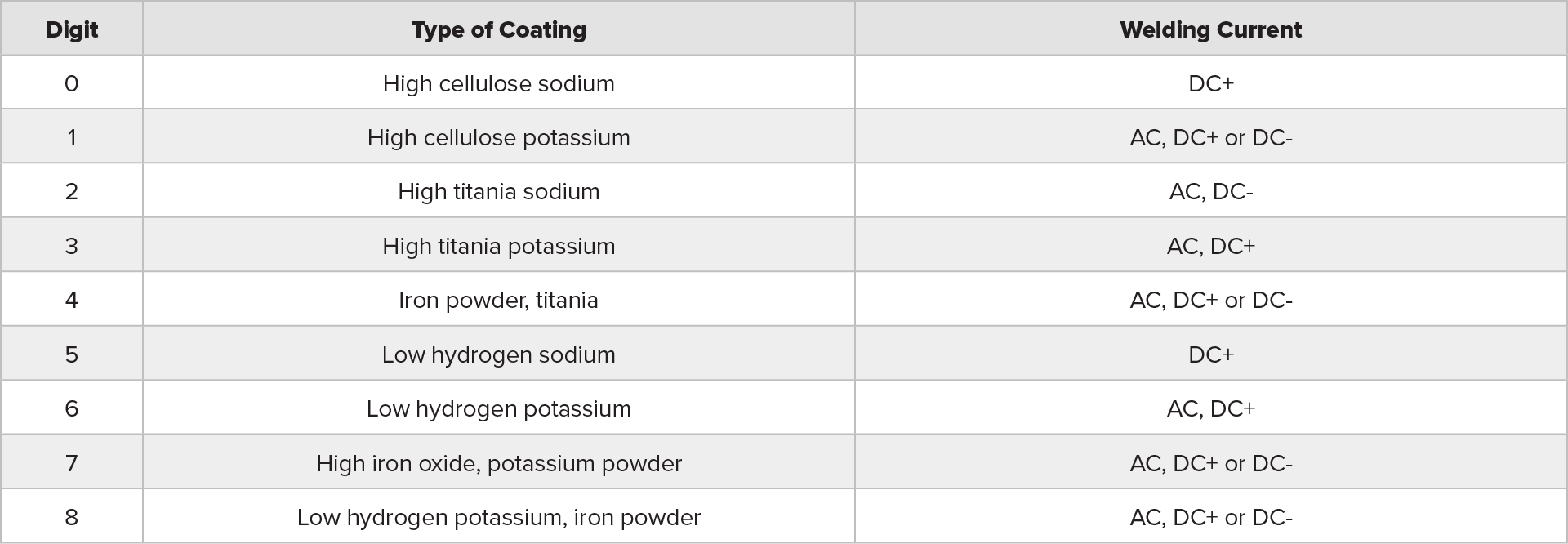
The fourth number is the type of flux coating on the electrode. This is the most varying part of every electrode, as there are 9 types of coating. The flux coating will determine how the weld puddle reacts.
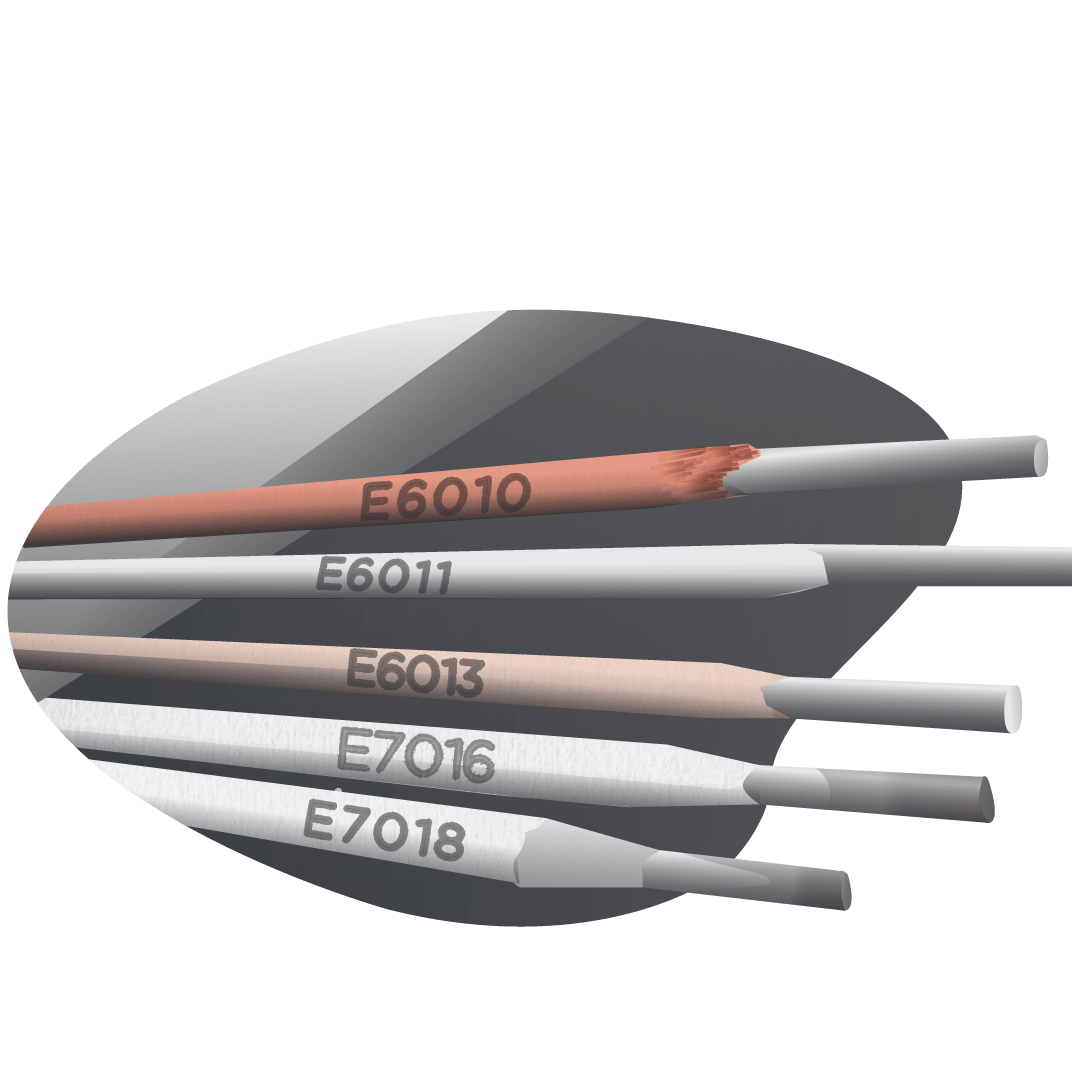
The most common stick electrode classifications in Australia are E6010, E6011, E6013, E7016, E7018 & E7024.
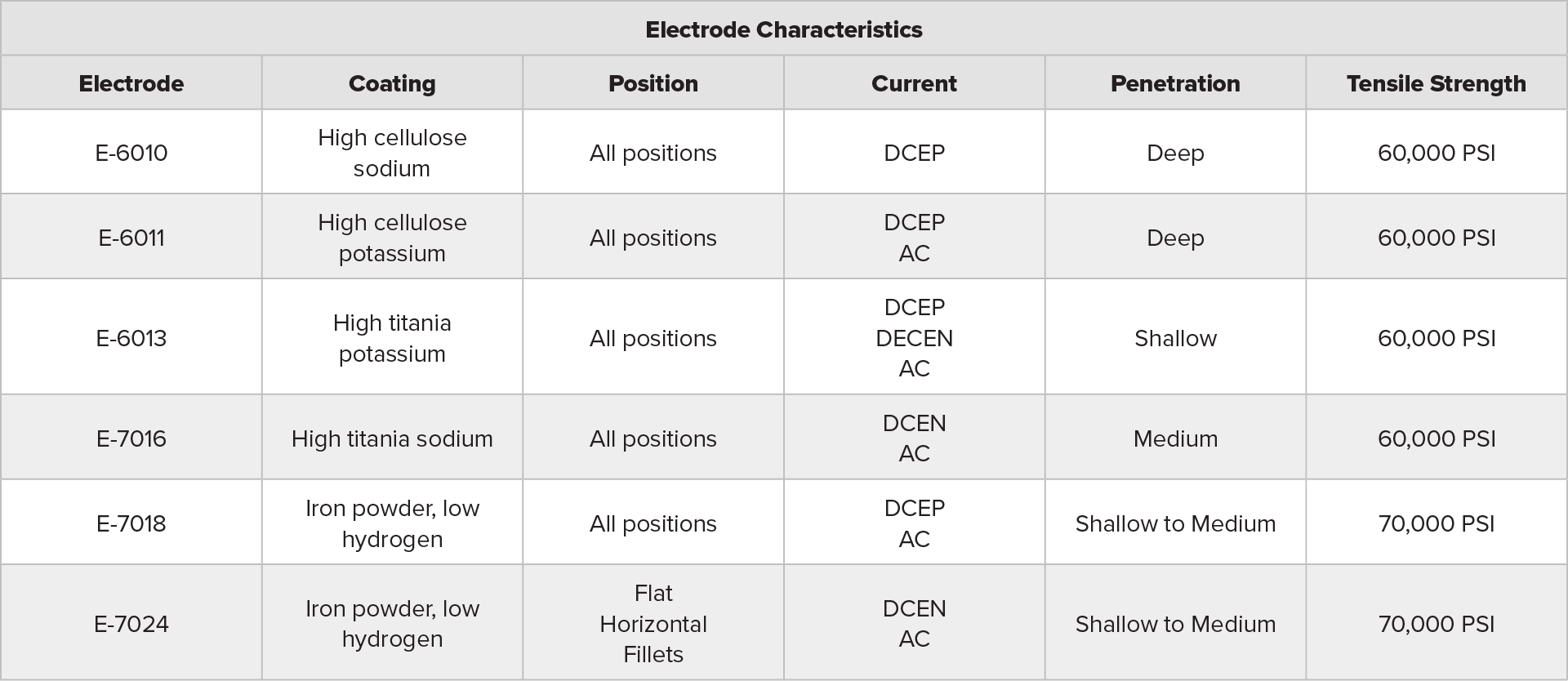
AS/NZS Electrode Identification
Similar to the AWS designation code, the AS/NZS classification aims to provide a more detailed look at the standards an electrode meets and its mechanical and chemical compositions.
Using the E6013 as an example again, its AS/NZS classification looks like this: AS/NZS 4855-B – E43 13 A.
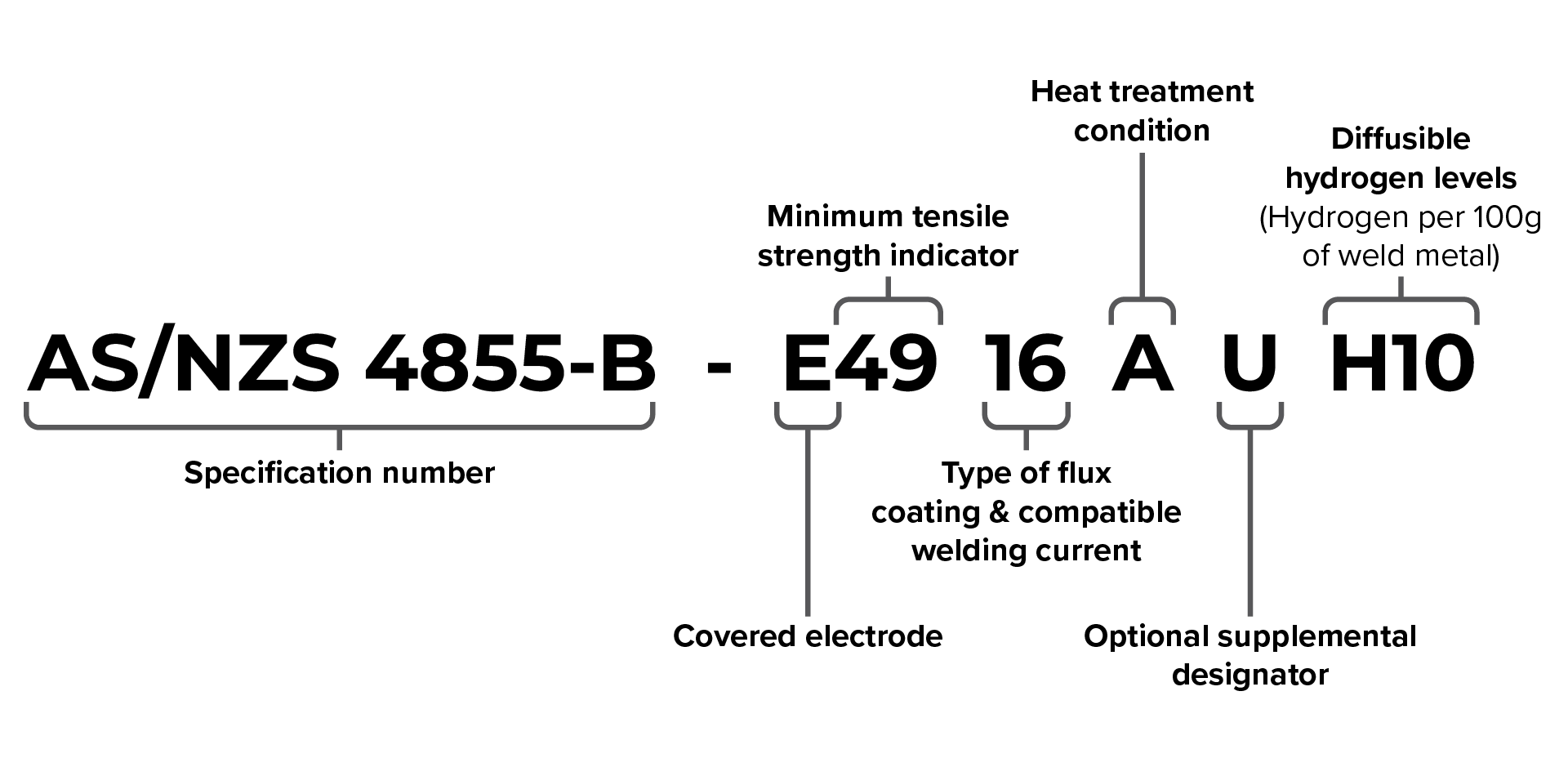
These digits each have a meaning that relates to the electrode’s characteristics and properties.
- The ‘AS/NZS 4855-B’ indicates the Australia/New Zealand standards they meet
- The ‘E’ indicates that it’s a covered electrode
- The next two digits after the E refer to the tensile strength (how much weight it can withstand after welding) of the electrode
- The 3rd & 4th digits indicate the position the electrode can be used in, the flux coating, and the current to be used (see below)
- The ‘A’ refers to the heat treatment condition
On an electrode like the E7016, the AS/NZS also includes some extra designators: AS/NZS 4855-B – E49 16 A U H10.
- The ‘U’ is an optional supplemental designator
- The ‘H10’ is the diffusible hydrogen level in the electrode (hydrogen per 100g of weld metal)
For AS/NZS classifications, the tensile strength is measured in MPa rather than psi. The ‘43’ or ‘49’ means these electrodes have a tensile strength of 430 MPa and 490 MPa, respectively.
The 3rd and 4th digits generally reflect what the AWS standards are, but here is a full list of the different codes:
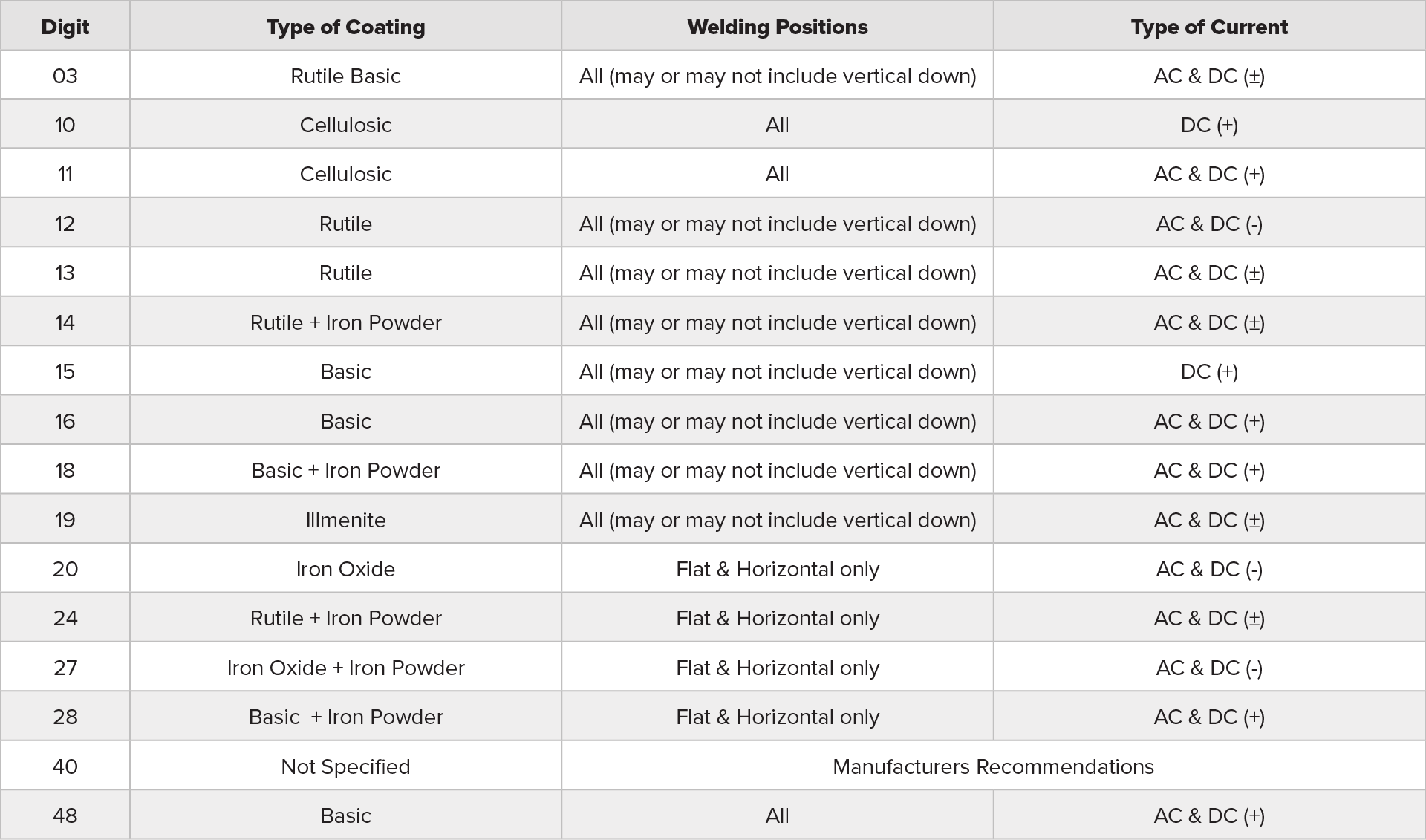
For the most part, the AWS classification is the most common, and all electrodes come with this stamped on them, even if they also include the AS/NZS classification in their paperwork.
Welding Current & Polarity
The correct welding current and polarity are significant for producing quality welds. Some stick electrodes might require AC to run, while others need DC. Some electrodes are capable of working on both.
For example, an E6013 electrode functions with either AC or DC, providing flexibility. The electrode’s coating will determine the power source the electrodes can run on.
If you’re working with an electrode that can be used on both AC and DC, or you can run it on DCEP (electrode positive) and DCEN (electrode negative), the polarity will affect the penetration depth and bead profile.
DCEN will put more heat into the workpiece, while DCEP will put more heat into the electrode.
Welding Position
As mentioned above, the third digit in an electrode’s AWS classification states the welding positions an electrode can be used for.
- 1 (all positions)
- 2 (flat & horizontal)
- 3 (flat only)
Most electrodes are coded with ‘1’ as they can do every position, though this doesn’t always include vertical down. The positions an electrode is suitable for are also determined by its coating and the characteristics of the weld pool as it welds.
Base Metal Considerations
The thickness and type of base metal are crucial factors for selecting the correct electrode. You’ll also need an electrode that matches or exceeds the metal’s tensile strength to ensure a durable weld.
The joint design and fit up also need to be considered when choosing an electrode. For thicker pieces, you’ll need deeper penetration, so you’ll also need an electrode that’s a suitable diameter.
Base Metal Thickness
The base metal thickness will determine your welding rod diameter and, therefore, your amperage, but it will also have an impact on characteristics like the ductility of the electrode.
When working with thick materials during welding, it is important to use an electrode with high ductility and low hydrogen content. Both of these factors will minimise the chances of the weld cracking from the residual stress in the metal, especially for multi-pass welds.
Thicker base metals will also require larger diameter electrodes to get proper penetration and lay down the necessary weld metal into the joint. In comparison, smaller diameter electrodes are used on thinner materials, reducing the needed amperage and the risk of burning through the metal.
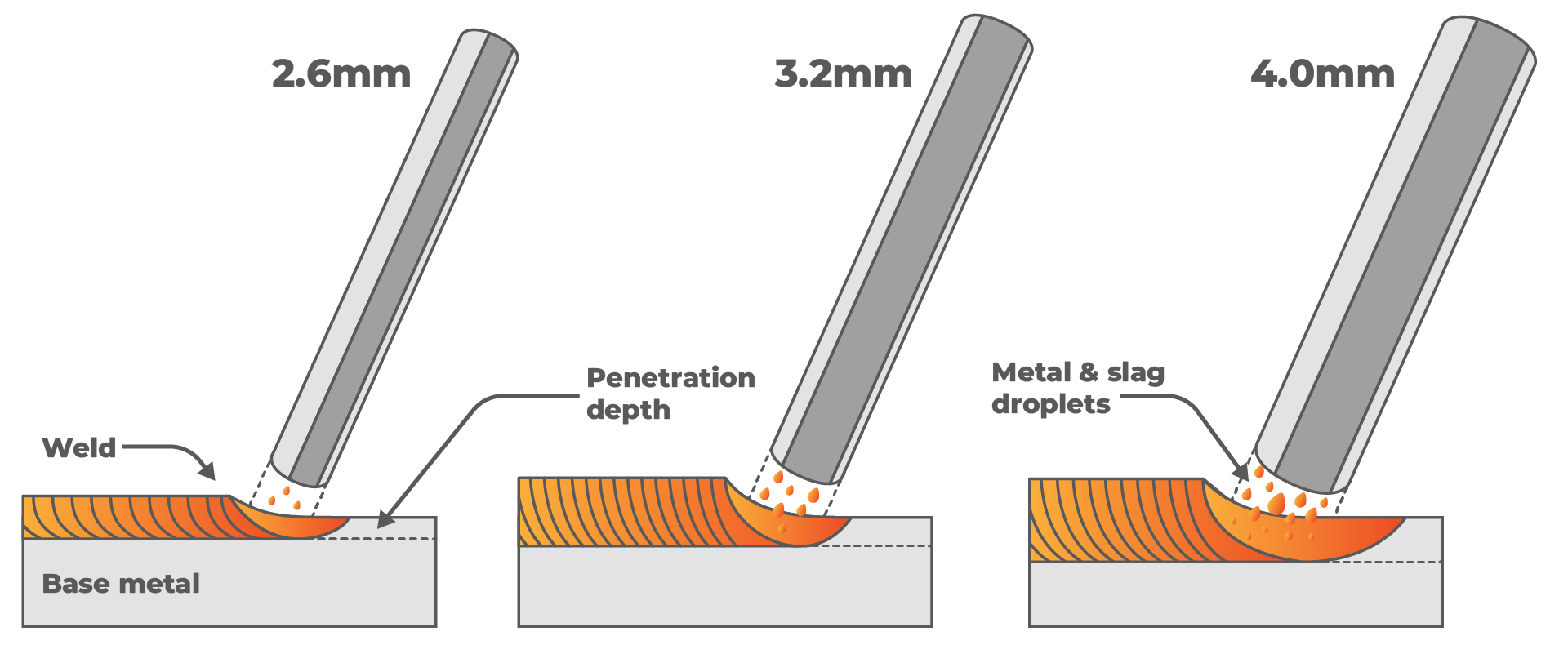
When picking the right size electrode for your job, the rule of thumb is generally to pick an electrode that is one step down from your material thickness. This only applies until 6mm, as the largest (widely available) electrode is 5.0mm.
From there, you can use an electrode that is about half the thickness of the base material as a minimum until you stop getting proper penetration. Then, you’ll need to begin doing multiple passes to ensure the weld will hold.

Keep in mind electrode packaging will include a recommended amperage range for that specific electrode type and diameter that you can use as a starting point.
Base Metal Tensile Strength
You need to select an electrode with the same tensile strength as the base material. If the strength of the electrode is less than the base metal, it can crack and fail.
The stick electrode’s tensile strength is represented by the first two digits of its AWS classification code. For example, the ‘70’ on a 7018 electrode indicates that it will produce a weld with a tensile strength of 70 ksi (70,000 psi).
Base Metal Shape & Joint Fit Up
The joint fit up and its shape (T-joint, butt joint, etc.) can impact your choice of electrode as well. If it’s a tight fit up, or there is no bevelling (especially on thick joints), you may prefer an electrode with a harsher ‘digging’ arc to get proper penetration.
For joints with a wide root gap, having an electrode suitable for bridging gaps will make the welding process easier.
What Does the Electrode Coating Do?
In stick welding, the electrode’s flux coating is essential to the process, as it stabilises the arc, protects the weld pool from contaminants, and improves the weld’s mechanical properties.
Coating Functions
- Arc stabilisation: ensuring a smooth, steady arc
- Protection against contamination: shielding the weld from oxygen, nitrogen, and other atmospheric contaminants
- Slag creation: forming a protective barrier over the cooling weld
The primary function of the electrode coating is to create a shield that protects the molten weld pool from atmospheric contamination. As you weld, the flux coating dissolves, producing a shielding gas that prevents oxidation. Simultaneously, the coating yields slag, a layer of flux residue that solidifies over the weld bead, protecting it during cooling.
Another crucial role it plays is stabilising the arc, which helps you maintain a consistent weld. Certain coatings can also remove impurities from the weld to keep it free from potential defects.
Types of Coatings
There are four main types of coatings used in stick welding electrodes, each designed to enhance performance under different conditions:
- Cellulose
- Rutile
- Low hydrogen
- Iron powder
Cellulose Electrodes
Cellulose electrodes have a high cellulose content, which results in a deep penetrating arc. They are primarily used for welding in all positions and are especially useful in vertical down welding.
The coating generates a gas shield dominated by hydrogen, ensuring minimal contamination of the weld area.
These electrodes are known for their ease of use, deep penetration, and fast deposition rates, making them ideal for welding thick materials or in situations where appearance is not the primary concern.
Rutile Electrodes
Rutile electrodes contain a high proportion of titanium dioxide (rutile) in the coating. This results in a very smooth arc, easy slag removal, and an attractive weld appearance.
They are generally easy to use, making them suitable for beginners or welding thin materials. These electrodes are often used for general-purpose welding, offering a balance between usability and quality.
Low Hydrogen/Hydrogen Controlled Electrodes
Low hydrogen electrodes are made up of calcium carbonates and fluorite. The coating on these electrodes also reduces the amount of diffusible hydrogen entering the weld pool. This characteristic is crucial for welding high-strength steels and in applications where cracking is a concern.
These electrodes require a higher skill level to be used effectively and often need to be stored in dry conditions to maintain their low-hydrogen properties.
They provide excellent mechanical properties and are often used in critical applications, such as pressure vessels, high-strength steel structures, and repair work where crack resistance is paramount.
Iron Powder Electrodes
Iron powder electrodes include iron metallic powder and provide a stable arc with fast-freezing slag.
Electrodes with an iron powder coating are known for their ability to increase the deposition rate and speed of welding. They facilitate higher currents, resulting in deeper penetration and faster welding speeds.
These electrodes are often used in applications where productivity is a key concern. However, the iron powder can lead to increased spatter and a rougher weld finish compared to rutile coatings.
Each coating type dictates the usability, weld appearance, and mechanical properties, making understanding these factors essential in picking the right electrode for the job.
Properties of Stick Electrodes
The electrodes’ properties determine their suitability for a particular application and the quality and durability of the weld produced.
Mechanical Properties
Tensile strength: the amount of stress the weld metal can withstand before failing. Electrodes are often classified by their minimum tensile strength; for instance, an E6011 electrode signifies a minimum tensile strength of 60,000 psi.
Ductility: defines how much the weld metal can deform before it breaks. Using an electrode with higher ductility means the weld can absorb more energy during impact or strain, which is often associated with a strong weld.
Chemical Composition
The composition of an electrode determines its compatibility with different base metals and the resulting mechanical properties of the weld. Electrodes may contain various elements that can enhance specific characteristics, such as strength or corrosion resistance.
For instance, a higher carbon content generally increases tensile strength but could make the weld and heat affected zone (HAZ) more brittle.
Electrode Handling & Storage
Proper handling and storage of your welding electrodes are essential to prevent rust, contamination, and moisture absorption, which can deteriorate electrode performance. Maintaining your electrodes will ensure their top performance on every weld.
To keep your electrodes free from moisture and contaminants, leave them in their original packaging until you need to use them. Once the package is open, you’ll need to store them properly to maintain their quality.
Store your electrodes in a cool, dry place. By storing them properly, your electrodes will retain their intended properties for defect-free welds.
Electrodes exposed to the atmosphere are at risk of absorbing moisture, which can lead to welding defects such as porosity or cracking. If electrodes get damp, they’ll need to be thrown out unless they’re low-hydrogen electrodes. Low-hydrogen electrodes can be baked dry in a designated oven to restore their performance.
Always handle your electrodes with clean hands or gloves to prevent oils and other contaminants from sticking to the surface.
Applications & Considerations
Choosing the right stick electrode involves understanding its applications and the specific considerations of the material you’ll be working with.
Industrial Applications
In the industrial sector, you’ll need to consider the conditions in which your welds will be operating. For pressure vessel or boiler fabrication, electrode selection is critical. You want to ensure your choice can withstand service conditions like high temperature or pressure.
In these instances, you’ll likely require electrodes capable of providing deep penetration to create strong, reliable joints.
Material Specific Applications
When it comes to material-specific applications, each metal type has unique welding characteristics. Mild steel, a common material, is typically welded with electrodes that ensure ductility and strength to cope with stresses.
For cast iron, an electrode that can account for its brittleness and tendency to crack is essential. When welding stainless steel, you need an electrode that can prevent corrosion at the weld joint.
Making the right choice for a stick welding electrode is crucial for the success of your welding project. Your selection should be informed by a combination of the base metal type, welding position, and desired mechanical properties.
- Evaluate the thickness of the base metal. A thicker base metal will typically require a thicker electrode for adequate penetration.
- Consider the welding position: not every electrode can do vertical or overhead welding.
What to Avoid When Choosing a Stick Electrode
Choosing the wrong stick electrode can lead to poor weld quality, unnecessary frustration, and even weld failure. Avoid these common mistakes when selecting your electrode.
Overmatching tensile strength unnecessarily
Using an electrode with a much higher tensile strength than the base metal does not automatically make the weld stronger. It can reduce ductility and increase the risk of cracking, especially on thinner or lower-strength steels.
Using the wrong electrode diameter
An electrode that is too large for the base metal can cause excessive penetration, burn through, or poor control of the weld pool. Always match the electrode size to the material thickness and joint design.
Ignoring welding position limitations
Not all electrodes are suitable for vertical or overhead welding. Using a flat-only electrode outside its intended position can lead to slag inclusions and a lack of fusion.
Running electrodes on the wrong current or polarity
Some electrodes are designed for specific current types or polarity. Running them incorrectly can cause unstable arcs, excessive spatter, and poor penetration.
Poor storage of low-hydrogen electrodes
Low-hydrogen electrodes must be kept dry. Using moisture-contaminated electrodes can introduce hydrogen into the weld, increasing the risk of cracking and weld defects.
Assuming one electrode suits every job
No single electrode is ideal for all applications. Base metal type, thickness, joint fit up, and service conditions should always guide your selection.
Selecting the correct electrode may seem daunting initially, but with practice and a clear understanding of the materials involved, you can make informed choices that lead to strong, durable welds.

